
Tribal knowledge can feel efficient when a business is small. The right person knows what to do, customers get served, the work gets done, and everyone moves on.
But as soon as the business grows, that same tribal knowledge becomes a liability.
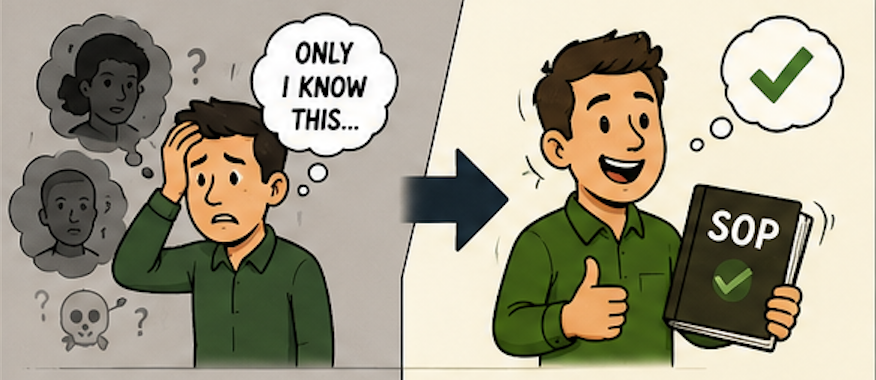
If a process only exists in an employee's head, the company does not truly own that process. It is borrowing it from the person who remembers how things work.
That matters because company value is not only based on revenue. It is also based on how transferable, repeatable, and dependable the operation is. Buyers, investors, operators, lenders, and leadership teams all want to know the same basic thing:
Can this business keep performing if the current owner, manager, or key employee steps away?

If the answer is unclear, the company feels riskier. Risk lowers value.
Tribal Knowledge Is a Value Problem
Most businesses do not set out to build around undocumented knowledge. It happens naturally.
A strong employee learns the customer quirks. A manager remembers how to handle exceptions. A founder knows which vendor to call, which report to pull, and which shortcut solves a recurring issue. Over time, those habits become the operating system of the company.
The problem is that the operating system is not visible.
When processes are invisible, training takes longer, mistakes are harder to diagnose, and leaders have less control over the customer experience. The business may still be profitable, but it becomes harder to scale and harder to explain to someone evaluating the company from the outside.
That is why tribal knowledge does not increase company value. It actively lowers it.
It creates key-person risk, slows onboarding, weakens consistency, and makes the company more dependent on individual memory than documented systems.
Buyers Pay for Clarity, Repeatability, and Control
Buyers and investors do not pay a premium for chaos. They pay for systems that can survive transition.
A business that depends on one or two people may be impressive, but it is also fragile. If those people leave, get overloaded, change roles, or stop sharing what they know, performance can drop quickly.
A documented operation tells a very different story. It shows that the company has captured the way work should be done and can teach that standard to other people.
That can strengthen the business in several ways:
- New employees can ramp faster because training is structured.
- Managers can hold teams accountable to a shared process.
- Customers receive a more consistent experience.
- Leadership can identify and improve weak steps in the workflow.
- The business becomes less exposed to turnover and role changes.
- A future buyer can understand how the company runs before taking over.
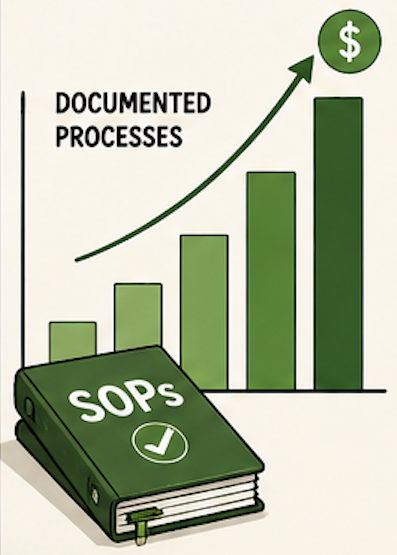
In other words, documentation does not just make the company neater. It makes the company more transferable.
Why a Documented SOP Platform Matters
A shared drive full of random documents is better than nothing, but it is not the same as a real SOP system.
A documented SOP platform gives the business a central place for training, policies, process steps, role expectations, and recurring procedures. More importantly, it makes that knowledge easier to assign, update, search, and verify.
The difference matters.
A static document can tell someone what to do. A platform can help the company manage whether the right people have seen it, learned it, and followed it.
A strong SOP platform should help answer practical operating questions:
- Where does this process live?
- Who owns it?
- Who needs to learn it?
- When was it last updated?
- Which employees have completed the related training?
- What should happen when the process changes?
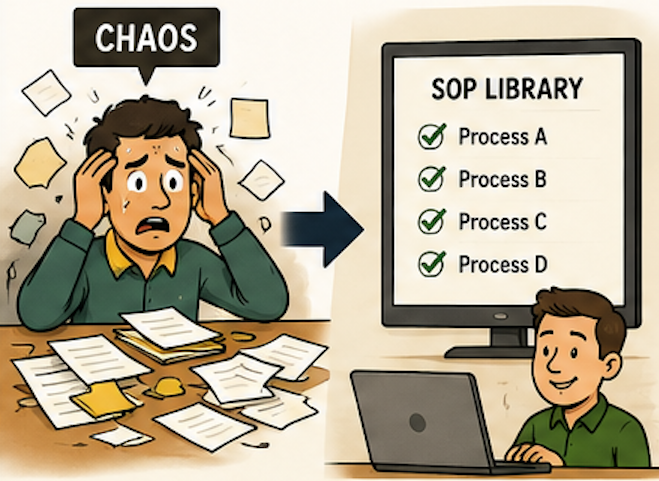
Those answers create operational confidence. They also reduce the amount of knowledge trapped in side conversations, private notes, inboxes, and memory.
Faster Onboarding Is Only the First Benefit
Faster onboarding is one of the easiest benefits to see.
When training is documented, a new hire does not have to depend entirely on whoever happens to be available that week. They can follow a clear path, learn the business vocabulary, understand role expectations, and see examples of how work should be completed.
That makes managers more effective too. Instead of repeating the same explanations every time someone joins, managers can spend more time coaching, answering better questions, and checking quality.
Good onboarding documentation often includes:
- Company policies and expectations
- Role responsibilities
- Common tools and how they are used
- Customer communication standards
- Step-by-step workflows
- Escalation rules
- Examples of completed work
- What good judgment looks like in common situations
The goal is not to remove human training. The goal is to make human training more consistent and less dependent on memory.
Less Dependence on Individual Employees
Great employees are valuable. The risk comes when the business cannot function without them.
If one person is the only one who knows how billing exceptions work, how vendor renewals are handled, how a customer issue gets escalated, or how a recurring report is built, the company has an avoidable vulnerability.
That vulnerability may not show up on the income statement today, but it shows up during turnover, vacation coverage, rapid growth, operational mistakes, and diligence conversations.
Documented SOPs reduce that risk by making knowledge easier to transfer. They help more than one person understand the workflow and give leaders a cleaner way to cross-train the team.
This does not make employees less important. It makes the company less fragile.
Consistent Customer Experiences Build Trust
Customers can feel operational inconsistency.
They notice when one employee handles an issue one way and another employee handles it differently. They notice when follow-up depends on who answered the phone. They notice when a process is smooth one month and confusing the next.
Documented SOPs help standardize the moments that matter.
That can include how inquiries are handled, how quotes are prepared, how onboarding is completed, how service issues are escalated, how renewals are reviewed, how payment questions are answered, and how customers are updated after a problem.
Consistency does not mean every customer interaction becomes robotic. It means the company has a shared baseline for quality.
That baseline protects the brand.
What to Document First
The hardest part is often deciding where to begin.
The best starting point is not documenting everything. That usually creates too much work and too little momentum. Start with the processes that create the most risk, repetition, or training burden.
Good first candidates include:
- New employee onboarding
- Customer onboarding
- Sales-to-operations handoff
- Billing, collections, and payment workflows
- Service escalation steps
- Compliance-sensitive procedures
- Recurring reporting
- Vendor renewals and procurement approvals
- System access, permissions, and offboarding
- Frequently repeated manager explanations
If a process creates frequent questions, repeated mistakes, customer confusion, compliance risk, or dependence on one person, it probably belongs near the top of the list.
How to Start Without Overbuilding
A useful SOP system does not need to launch as a massive documentation project.
Start with a simple operating rhythm:
- List the workflows that employees ask about most often.
- Choose the top five processes that create the most risk or repetition.
- Assign an owner for each process.
- Document the current best-known way to complete the work.
- Add screenshots, examples, templates, and decision rules where helpful.
- Train the relevant employees on the documented version.
- Review the process after real use and improve it.
The first version does not need to be perfect. It needs to be findable, usable, and owned.
That ownership point is important. An SOP without an owner slowly becomes stale. Once employees stop trusting the documentation, they go back to asking the nearest expert. Then tribal knowledge comes back through the side door.
Technology Helps When the Operating Habit Is Clear
Technology can make SOP documentation easier to maintain, but the tool is not the whole answer.
The company still needs to decide who owns each process, who approves changes, how training is assigned, how often content is reviewed, and which workflows deserve priority.
That said, the right platform can make the habit much easier to sustain. A dedicated system can help organize knowledge by role, department, or workflow; assign training; track completion; and keep policies and procedures easier to find.
For teams evaluating this category, Trainual is one option RootPath helps clients consider. It is built around onboarding, SOPs, policies, role-based training, and process documentation for growing teams.
The key is fit. Some businesses need a lightweight documentation system. Others need a learning management system, HR platform, knowledge base, compliance tool, or a mix of several systems. The best choice depends on company size, training needs, documentation maturity, and how employees actually work.
In Summary
Tribal knowledge may feel harmless when the right people are still in place, but it makes the company harder to train, harder to scale, harder to sell, and harder to protect.
Documented SOPs turn scattered knowledge into repeatable systems. They reduce key-person risk, create clearer onboarding, support more consistent customer experiences, and give leadership a better way to manage the business.
That is why documentation should not be treated as an administrative cleanup project. It is value creation.

Buyers, investors, operators, and leadership teams do not pay a premium for chaos. They pay for clarity, repeatability, and systems that can scale.
If you want to explore an SOP documentation platform, you can visit Trainual here. If you want help comparing Trainual against other training, knowledge management, HR, or operations tools, RootPath Advisors can help evaluate the right fit for your business.